


The problem hiding behind your cladding
Condensation inside walls — known as interstitial condensation — is one of the most damaging and least visible problems in Australian residential construction. It doesn’t announce itself. There’s no leak, no drip, no obvious sign that anything is wrong. Until one day there is.
By the time you see mould on internal walls, ghosting on external cladding, or structural rot when a wall is opened up for renovation, the damage has been accumulating for years. And under Australian law, the builder carries liability for non-compliant construction for up to seven years.
Understanding what causes condensation inside walls — and designing wall assemblies that prevent it — isn’t optional anymore. The NCC is making that clearer with every revision.
How condensation forms inside a wall
Warm air holds more moisture than cold air. When warm, humid air inside a home moves through the wall assembly and reaches a cooler surface — typically near the cladding in winter — it cools below its dew point. The moisture condenses. Where does it go?
In a sealed wall cavity with no drainage or ventilation path, it stays. It soaks into timber framing, sits on steel members, saturates insulation batts, and creates the perfect environment for mould growth.
This process is particularly acute in climate zones 6, 7, and 8 — covering large parts of New South Wales, Victoria, South Australia, all of Tasmania, and southern Western Australia — where cold winters create a strong temperature gradient across the wall.
But it’s not just a cold-climate problem. In tropical and subtropical zones where air conditioning runs for much of the year, the process reverses: the internal linings become the cold surface, and condensation can occur on the inside of the wall assembly. As Australian homes become more tightly sealed for energy efficiency, this problem is growing.
What condensation does to your wall
Structural damage. Moisture rots timber framing or corrodes steel framing. It soaks wall batts so they don’t perform as intended — wet insulation has a fraction of the R-value of dry insulation. By the time you can see the damage, the repair bill is significant.
Mould and health risks. Mould growth inside walls affects indoor air quality. Occupants experience respiratory issues, allergic reactions, and worse. This isn’t just a building defect — it’s a health liability.
Ghosting on external walls. That dark shadow pattern that appears on the outside of cladding? It’s condensation damage showing through. Homeowners notice, and they call. Simply painting over it is not the answer.
Soaked insulation. Wall batts that are supposed to deliver R2.7 performance don’t deliver anything close when they’re damp. The wall’s thermal performance degrades, energy costs rise, and the home is less comfortable — the opposite of what the insulation was supposed to achieve.
Energy efficiency and condensation management need to work together to be effective for comfort and health. One without the other creates problems.
Why ‘more insulation’ doesn’t fix condensation
The instinct when a wall underperforms thermally is to add more insulation. But condensation isn’t a thermal performance problem — it’s a moisture management problem. Adding thicker batts doesn’t give moisture anywhere to go. In fact, stuffing R2.7 batts into a wall frame can make it worse by bulging into the cavity space and blocking the airflow that should be drying the wall out.
The solution is a properly drained and ventilated cavity — a gap between the frame and the cladding where moisture can drain downward and air can circulate. This is the approach recommended by building scientists and increasingly recognised by the NCC.
What the NCC now requires for condensation management
The condensation management provisions in NCC Volume Two – Part H4 Health and Amenity and the Housing Provisions Part 10.8 work alongside the energy efficiency requirements.
NCC 2025 introduces mandatory 12mm wide cavities behind all external cladding, a minimum ventilation rate to the cavity of 1000mm²/m at the top and bottom, and a completely clear cavity with no protrusions of membranes or bulging insulation. In climate zones 6, 7, and 8, drained and ventilated cavities are mandatory.
NCC 2025 also clarifies what class of building membrane is required with or without a drained and ventilated cavity. The days of treating the membrane as just a rain screen are gone — building science and overseas experience have shown that membranes must be properly installed and work as part of a complete moisture management system. There is an Australian Standard As4200.2 referenced by the NCC that specifies how to install pliable building membranes for the function/s they carry out.
The wall design approach that prevents condensation
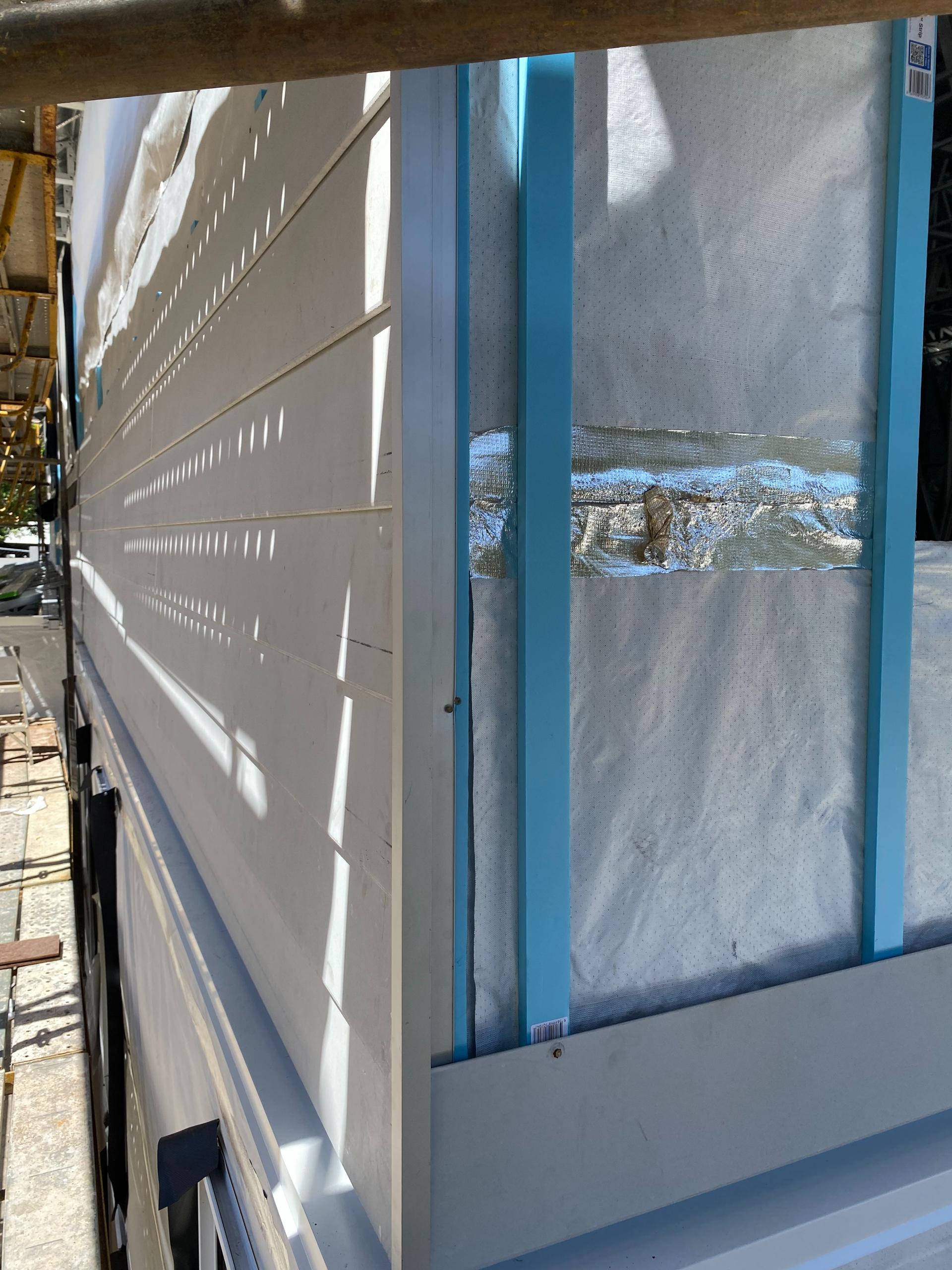
A thermal break that creates a genuine 20mm cavity space addresses both thermal bridging and moisture management with some room for tolerance in the construction. The cavity needs to be deep enough for water to drain and air to move — and clear enough that nothing blocks the path.
A 12mm strip technically creates the minimum NCC gap, but it leaves no margin for real-world conditions: membranes that aren’t perfectly taut, insulation that bulges slightly, or construction tolerances that eat into the space. A 20mm cavity gives genuine room for the system to work.
The material matters too. The thermal break sits inside the wall for the life of the building. Timber battens rot. Pine mouldings attract termites and aren’t treated for decades of moisture exposure. XPS (extruded polystyrene) is waterproof, mould-resistant, pest-resistant, and dimensionally stable — it won’t degrade in the environment it’s designed to sit in.
ATI’s Cavi-Break® + Cavi-Vent®: Thermal performance and condensation management in one system.
Cavi-Break creates a 20mm drained cavity with an R-value of 0.58 (3x NCC minimum). Cavi-Vent adds integrated ventilation channels for complete moisture management. Together they create the wall system that building scientists recommend — and that the NCC is increasingly mandating.
Builders like Alroe Constructions and Armada have adopted the system for confidence in long-term wall performance and condensation prevention.
Your next step
If you’re building in any Australian climate zone with lightweight cladding, it’s worth understanding how your current wall assembly manages moisture. ATI’s free Total Wall R-Value Comparison tool lets you model different thermal break and insulation combinations — so you can see both the thermal and the cost implications.
Request a sample from ATI and see the system for yourself. Peel one strip, stick it to a stud, and decide.
Australian Thermal Industries manufactures Cavi-Break® and Cavi-Vent® — high-performance thermal break and cavity ventilation systems for Australian residential and light commercial construction. 10-year warranty. 100% recyclable. Independently tested.
#CondensationManagement #WallCondensation #NCC2025 #BuildingEnvelope #AustralianBuilding #CaviBreak #CaviVent
